
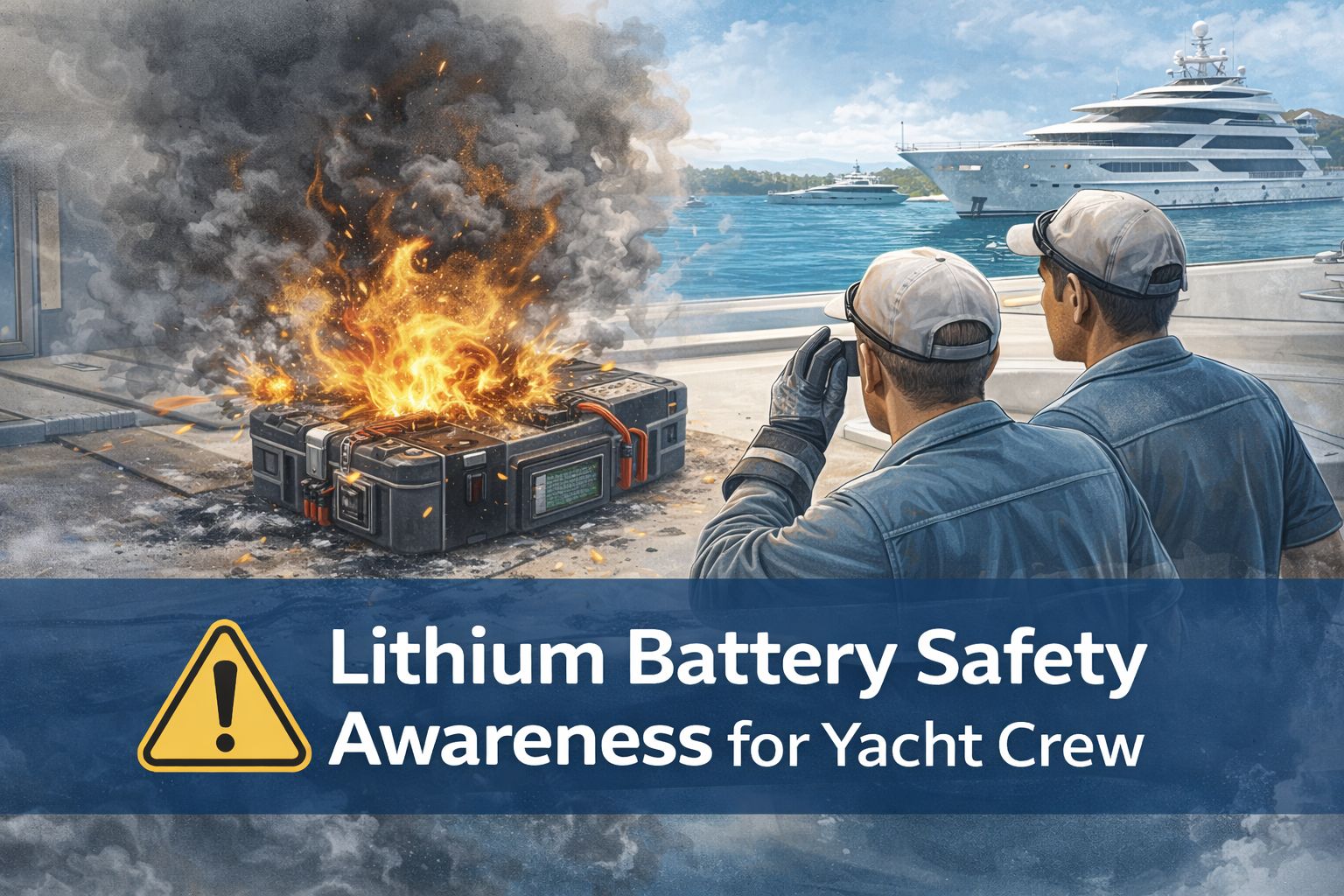
Course Content
Module 1: Introduction & Risk Context
You don't currently have access to this content
5 Topics
1 Quiz
1.1 Why Lithium Batteries Matter on Yachts
You don't currently have access to this content
1.2 Where Lithium Batteries Are Found Onboard
You don't currently have access to this content
1.3 Why Yachts Are a High-Risk Environment
You don't currently have access to this content
1.4 Consequences of Lithium Battery Failure Onboard
You don't currently have access to this content
1.5 Individual Crew Responsibility
You don't currently have access to this content
Assessment
You don't currently have access to this content
Module 2: Lithium Battery Fundamentals
You don't currently have access to this content
9 Topics
1 Quiz
2.1 Why Crew Need to Understand the Basics
You don't currently have access to this content
2.2 What a Lithium Battery Actually Is
You don't currently have access to this content
2.3 Inside a Lithium Battery Cell
You don't currently have access to this content
2.4 How Energy Is Stored and Released
You don't currently have access to this content
2.5 Common Lithium Battery Chemistries Found Onboard Yachts
You don't currently have access to this content
2.6 Energy Density Explained (Why Size Is Misleading)
You don't currently have access to this content
2.7 Battery Management Systems (BMS): What They Do — and Don’t Do
You don't currently have access to this content
2.8 Lithium vs Lead-Acid Batteries (Why Old Assumptions Fail)
You don't currently have access to this content
2.9 Why Damage Is Often Delayed
You don't currently have access to this content
Assessment
You don't currently have access to this content
Module 3: Lithium Battery Fundamentals
You don't currently have access to this content
10 Topics
1 Quiz
3.1 Why Most Lithium Battery Fires Are Crew-Created
You don't currently have access to this content
3.2 The Concept of Failure Pathways
You don't currently have access to this content
3.3 Mechanical Damage (The Silent Trigger)
You don't currently have access to this content
3.4 Electrical Stress: Overcharging and Mismatched Chargers
You don't currently have access to this content
3.5 Thermal Stress: Heat Is the Enemy
You don't currently have access to this content
3.6 Water and Salt Contamination
You don't currently have access to this content
3.7 What Thermal Runaway Actually Is
You don't currently have access to this content
3.8 Early Warning Signs (Often Missed)
You don't currently have access to this content
3.9 Why Multiple Batteries Increase Risk Exponentially
You don't currently have access to this content
3.10 Real Yacht Incident (Instructional)
You don't currently have access to this content
Assessment
You don't currently have access to this content
Module 4: Safe Storage, Charging & Onboard Management of Lithium Batteries
You don't currently have access to this content
10 Topics
1 Quiz
4.1 Why Storage and Charging Are the Highest-Risk Activities
You don't currently have access to this content
4.2 The Myth of “Out of the Way” Storage
You don't currently have access to this content
4.3 Principles of Safe Lithium Battery Storage
You don't currently have access to this content
4.4 Charging: Where Risk Peaks
You don't currently have access to this content
4.5 Approved Chargers Only (No Exceptions)
You don't currently have access to this content
4.6 Charging Location Selection
You don't currently have access to this content
4.7 Battery Quantity Management
You don't currently have access to this content
4.8 Storage State of Charge
You don't currently have access to this content
4.9 Handling Damaged or Suspect Batteries
You don't currently have access to this content
4.10 Real Yacht Incident (Instructional)
You don't currently have access to this content
Assessment
You don't currently have access to this content
Module 5: Inspection, Lifecycle Management & Disposal of Lithium Batteries
You don't currently have access to this content
10 Topics
1 Quiz
5.1 Why “Old but Working” Is a Dangerous Category
You don't currently have access to this content
5.2 Lithium Battery Aging: What Actually Degrades
You don't currently have access to this content
5.3 Cycle Life and Real-World Yacht Use
You don't currently have access to this content
5.4 Inspection: What Crew Should Actually Look For
You don't currently have access to this content
5.5 Inspection Frequency and Responsibility
You don't currently have access to this content
5.6 Battery Identification and Tracking
You don't currently have access to this content
5.7 End-of-Life: Knowing When to Retire a Battery
You don't currently have access to this content
5.8 Safe Temporary Storage of Retired Batteries
You don't currently have access to this content
5.9 Disposal: Why Lithium Batteries Are Not “Trash”
You don't currently have access to this content
5.10 Real Yacht Incident (Instructional)
You don't currently have access to this content
Assessment
You don't currently have access to this content
Module 6: Recognising Escalation & Making Early Intervention Decisions
You don't currently have access to this content
16 Topics
1 Quiz
6.1 Why Early Intervention Matters More Than Firefighting
You don't currently have access to this content
6.2 Escalation Is a Process, Not a Moment
You don't currently have access to this content
6.3 Behavioural Changes That Signal Escalation
You don't currently have access to this content
6.4 Sensory Warning Signs
You don't currently have access to this content
6.5 Decision Thresholds: When Monitoring Becomes Action
You don't currently have access to this content
6.6 Isolation: The Most Powerful Early Response
You don't currently have access to this content
6.7 Common Hesitation Errors
You don't currently have access to this content
6.8 Risk to the Vessel vs Risk to Equipment
You don't currently have access to this content
6.9 Real Yacht Incident (Instructional)
You don't currently have access to this content
6.10 Standard Operating Procedures (SOPs) as a Primary Risk Control
You don't currently have access to this content
6.11 Why SOPs Matter for Lithium Battery Risk
You don't currently have access to this content
6.12 What a Lithium Battery SOP Should Cover
You don't currently have access to this content
6.13 SOPs as Escalation Triggers
You don't currently have access to this content
6.14 SOPs and Authority to Act
You don't currently have access to this content
6.15 SOPs as Training Reinforcement
You don't currently have access to this content
6.16 SOPs as Incident Protection
You don't currently have access to this content
Assessment
You don't currently have access to this content
Module 7: Emergency Response to Lithium Battery Escalation, Thermal Runaway & Fire
You don't currently have access to this content
10 Topics
1 Quiz
7.1 Why Lithium Battery Emergencies Are Different
You don't currently have access to this content
7.2 The Crew Response Timeline
You don't currently have access to this content
7.3 Integration With SOP (No Improvisation)
You don't currently have access to this content
7.4 STAGE 1 — Abnormal Battery Identified (Pre-Escalation)
You don't currently have access to this content
7.5 STAGE 2 — Escalation Confirmed (Pre-Ignition)
You don't currently have access to this content
7.6 STAGE 3 — Thermal Runaway / Fire
You don't currently have access to this content
7.7 Firefighting Strategy (Reality-Based)
You don't currently have access to this content
7.8 Post-Fire & Re-Ignition Risk
You don't currently have access to this content
7.9 Crew Psychology Under Lithium Battery Events
You don't currently have access to this content
7.10 Real Yacht Incident (Instructional)
You don't currently have access to this content
Assessment
You don't currently have access to this content
Annex
You don't currently have access to this content
